How to understand gradient descent?

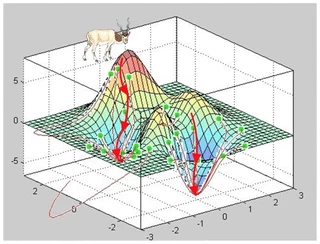
Gradient descent is a first-order iterative optimization algorithm for finding a local minimum of a differentiable function. To find a local minimum of a function using gradient descent, we take steps proportional to the negative of the gradient (or approximate gradient) of the function at the current point. But if we instead take steps proportional to the positive of the gradient, we approach a local maximum of that function; the procedure is then known as gradient ascent. Gradient descent is generally attributed to Cauchy, who first suggested it in 1847, but its convergence properties for non-linear optimization problems were first studied by Haskell Curry in 1944.
Click read more to read full article.

I am a research-oriented machine learning systems engineer working on foundation model infrastructure, closed-loop evaluation and optimization systems, and scalable AI platforms. My work focuses on building reliable Model-as-a-Service and Harness-as-a-Service platforms that connect data, training, inference, evaluation, and feedback loops into measurable, continuously improving AI products.
My recent work centers on Model-as-a-Service platforms and high-performance LLM inference. I develop serving infrastructure with vLLM and SGLang across model runtime integration, scheduling and continuous batching, KV-cache and memory management, distributed execution, observability, and reliability. This systems work is closely connected to my research on distributed disaggregated inference, preference optimization, instruction-tuning data selection, multimodal evaluation.
My broader research centers on reinforcement learning infrastructure and reinforcement learning optimization algorithms for scalable AI systems. I am interested in how policy optimization, reward modeling, preference learning, offline RL, simulation environments, distributed rollout systems, and automated evaluation harnesses can be engineered together to improve model behavior. My goal is to build frontier AI systems that learn from feedback efficiently, evaluate progress rigorously, and remain dependable when deployed at scale.